> ## Documentation Index
> Fetch the complete documentation index at: https://agno-v2-docs-scavio-google-v2.mintlify.site/llms.txt
> Use this file to discover all available pages before exploring further.
# Conversational Workflows
> Route messages between workflow history and execution with WorkflowAgent.
v2.2.6
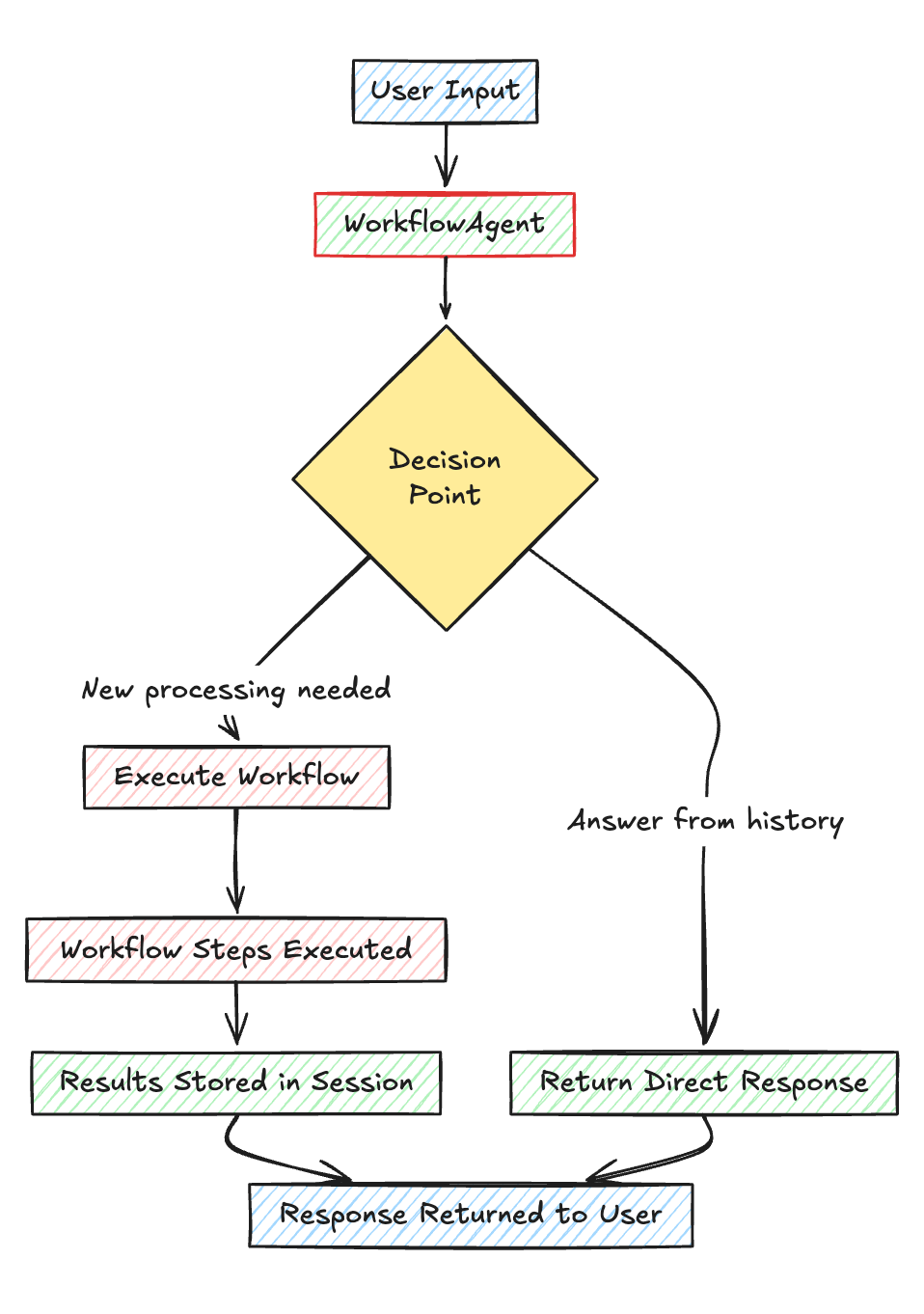
Add a `WorkflowAgent` to give a workflow a multi-turn interface. For each message, the agent either answers from recent workflow history or runs the workflow for new work.
## Quick Start
```python theme={null}
from agno.db.sqlite import SqliteDb
from agno.models.openai import OpenAIResponses
from agno.workflow import Step, WorkflowAgent
from agno.workflow.types import StepInput, StepOutput
from agno.workflow.workflow import Workflow
def draft_response(step_input: StepInput) -> StepOutput:
return StepOutput(content=f"Processed: {step_input.input}")
workflow_agent = WorkflowAgent(
model=OpenAIResponses(id="gpt-5.2"),
num_history_runs=4,
)
workflow = Workflow(
name="support_workflow",
description="Process support requests",
agent=workflow_agent,
steps=[Step(name="draft_response", executor=draft_response)],
db=SqliteDb(db_file="workflow.db"),
)
```
`WorkflowAgent` is a restricted `Agent` configured for workflow orchestration. The workflow supplies its `run_workflow` tool.
## Architecture
 ## Workflow History for Conversational Workflows
The `WorkflowAgent` receives recent workflow runs from the current session. This context supports follow-up questions and comparisons across prior results.
| Parameter | Default | Description |
| ---------------------- | ------- | --------------------------------------------- |
| `add_workflow_history` | `True` | Add recent workflow runs to the agent context |
| `num_history_runs` | `5` | Maximum number of recent runs to include |
Configure a database on the workflow to persist session history between process restarts. See [Workflow history](/history/workflow/overview).
## Instructions for the WorkflowAgent
The default instructions direct the agent to answer from history when possible and call `run_workflow` once for new work. Pass `instructions` to replace that decision policy. Workflow context is appended automatically unless the instructions already contain `{workflow_context}`.
```python theme={null}
workflow_agent = WorkflowAgent(
model=OpenAIResponses(id="gpt-5.2"),
num_history_runs=4,
instructions="You are a helpful assistant that can answer questions and run workflows when new processing is needed.",
)
```
## Usage Example
```python theme={null}
from agno.agent import Agent
from agno.db.postgres import PostgresDb
from agno.models.openai import OpenAIResponses
from agno.workflow import WorkflowAgent
from agno.workflow.types import StepInput
from agno.workflow.workflow import Workflow
db_url = "postgresql+psycopg://ai:ai@localhost:5532/ai"
story_writer = Agent(
model=OpenAIResponses(id="gpt-5.2"),
instructions="Write a 100-word story about the requested topic.",
)
story_formatter = Agent(
model=OpenAIResponses(id="gpt-5.2"),
instructions="Format the story into a prologue, body, and epilogue.",
)
def add_references(step_input: StepInput) -> str:
previous_output = step_input.previous_step_content or ""
return previous_output + "\n\nReferences: https://www.agno.com"
workflow_agent = WorkflowAgent(model=OpenAIResponses(id="gpt-5.2"), num_history_runs=4)
workflow = Workflow(
name="Story Generation Workflow",
description="A workflow that generates stories, formats them, and adds references",
agent=workflow_agent,
steps=[story_writer, story_formatter, add_references],
db=PostgresDb(db_url),
)
# New topic
workflow.print_response(
"Tell me a story about a dog named Rocky", stream=True
)
# Follow-up about a previous result
workflow.print_response(
"What was Rocky's personality?", stream=True
)
# Another new topic
workflow.print_response(
"Now tell me a story about a cat named Luna", stream=True
)
# Comparison across previous results
workflow.print_response(
"Compare Rocky and Luna", stream=True
)
```
## Developer Resources
* [Workflow Agent Examples](/examples/workflows/advanced-concepts/workflow-agent/overview)
## Workflow History for Conversational Workflows
The `WorkflowAgent` receives recent workflow runs from the current session. This context supports follow-up questions and comparisons across prior results.
| Parameter | Default | Description |
| ---------------------- | ------- | --------------------------------------------- |
| `add_workflow_history` | `True` | Add recent workflow runs to the agent context |
| `num_history_runs` | `5` | Maximum number of recent runs to include |
Configure a database on the workflow to persist session history between process restarts. See [Workflow history](/history/workflow/overview).
## Instructions for the WorkflowAgent
The default instructions direct the agent to answer from history when possible and call `run_workflow` once for new work. Pass `instructions` to replace that decision policy. Workflow context is appended automatically unless the instructions already contain `{workflow_context}`.
```python theme={null}
workflow_agent = WorkflowAgent(
model=OpenAIResponses(id="gpt-5.2"),
num_history_runs=4,
instructions="You are a helpful assistant that can answer questions and run workflows when new processing is needed.",
)
```
## Usage Example
```python theme={null}
from agno.agent import Agent
from agno.db.postgres import PostgresDb
from agno.models.openai import OpenAIResponses
from agno.workflow import WorkflowAgent
from agno.workflow.types import StepInput
from agno.workflow.workflow import Workflow
db_url = "postgresql+psycopg://ai:ai@localhost:5532/ai"
story_writer = Agent(
model=OpenAIResponses(id="gpt-5.2"),
instructions="Write a 100-word story about the requested topic.",
)
story_formatter = Agent(
model=OpenAIResponses(id="gpt-5.2"),
instructions="Format the story into a prologue, body, and epilogue.",
)
def add_references(step_input: StepInput) -> str:
previous_output = step_input.previous_step_content or ""
return previous_output + "\n\nReferences: https://www.agno.com"
workflow_agent = WorkflowAgent(model=OpenAIResponses(id="gpt-5.2"), num_history_runs=4)
workflow = Workflow(
name="Story Generation Workflow",
description="A workflow that generates stories, formats them, and adds references",
agent=workflow_agent,
steps=[story_writer, story_formatter, add_references],
db=PostgresDb(db_url),
)
# New topic
workflow.print_response(
"Tell me a story about a dog named Rocky", stream=True
)
# Follow-up about a previous result
workflow.print_response(
"What was Rocky's personality?", stream=True
)
# Another new topic
workflow.print_response(
"Now tell me a story about a cat named Luna", stream=True
)
# Comparison across previous results
workflow.print_response(
"Compare Rocky and Luna", stream=True
)
```
## Developer Resources
* [Workflow Agent Examples](/examples/workflows/advanced-concepts/workflow-agent/overview)